MG Metro 6R4 - The Gates Gamble
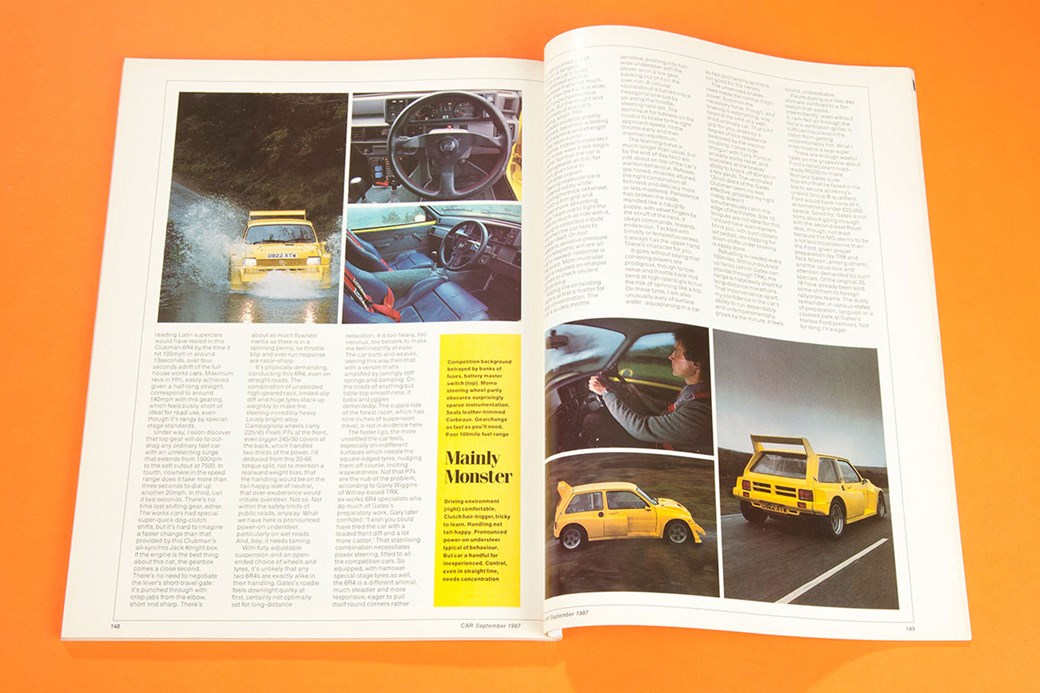
Car Magazine reviews 1987 Archive, author Roger Bell, my late father, drives the street legal MG Metro 6R4 one of the last 35 6R4's all bought by Harlow based dealer Gates Ford, for nearly half a million pounds, to be sold as turn key street legal monsters. At the time the article was published, Gates had sold 18 of the 35, and not all for road use. Thinking now, 35 6R4's for £500k, even allowing for inflation and other factors, sounds like a bargain amongst today's multi million pound restomods and supercars.
"If you have Jaguar money to spend and fancy yourself a mean steerer of a car, the machine that may just call your bluff is patiently waiting. Austin Rover’s excess stock of 6R4s has been corralled by one enterprising company, and carpeted, ventilated, tuned and polished to showroom condition. Your mission, should you accept it, is to try to tame a car that will suffer fools not at all, and will-out perform a GTO to 60mph. The stirring sound comes first. That deep-throated double-edged wail of the 90deg V6 is unmistakable. Once heard, never forgotten: you could always pick it out in the forests from the hysterical scream of rival four-cylinder turbos, its hard exhaust note reverberating through the trees. Then it bursts into view, not through the conifers this time but thrusting between two taxis in the rush-hour traffic, like a beacon in dayglow yellow.


It is not a pretty site, Rover’s 6R4 Group B rally car, but it is dramatically conspicuous with its huge aerofoils, wart-hog bonnet and muscle-bound haunches. It takes a moment or two to see why this one looks slightly less bizarre and ugly than all the others. The decal-free one-colour livery helps, not least to camouflage some of the more outrageous body excrescences. There is something else, though: it isn’t sitting up awkwardly on long-travel suspension.
There is no need for special-stage clearance on this car. It can hug the cats’ eyes on lowered springs, its huge, ultra low-profile tyres spread-eagled in the arches to good cosmetic effect. The car rattles onto the forecourt of Gates’s Harlow-based Ford dealership, tyres rumbling, transmission chattering. So this is it. This is the car that Austin Rover’s motorsport people said was not a feasible proposition. Here is a 6R4 kitted out for the road, taxes paid, legally approved. ‘Customers can specify more or less what they want,’ explains Richard Gates, one of the men behind the project fronted by former rally driver Sir Peter Moon.
In a deal worth nearly £500,000, Austin Rover was relieved of 35 unsold 6R4s, the last of those remaining from the 220 or so built to satisfy Group B competition rules. Too bad if you missed AR’s final bargain-basement kit-car price of £16,500, plus car tax and VAT. There are no 6R4s left now at Cowley’s run-down competition department, bereft of future stimulating projects. The national rally programme has been terminated. Even the Metro and Maestro Challenges are to be farmed out elsewhere.
Welcome to the civilised 6R4. Granny would be at home in here, in the nicely upholstered cockpit – though she’d have trouble clambering over the wide side sills linking the huge wheel-arch extensions. The fully trimmed steer doors clunk shut just as they do in a normal Metro. The windows wind up and down, the facia vents blow cold air, the heater heats, the hazard flashers flash. All is quite normal, save for a red battery master switch and a bank of exposed fuses, row upon row of them, that betray the car’s ancestry.
I am comfortably seated, nicely relaxed in a leather-trimmed Corbeau seat, anchored to the car’s massive tubular steel space frame by a full belts-and-braces harness, softly padded at the shoulder straps. Ahead, a thick-rimmed Momo steering wheel and a moulded Metro dash, notable for the absence of numerous dials and gadgets found in a forest racer. There’s not even an oil pressure gauge or an ammeter: fuel, water temperature, speedo and tacho. That’s all, apart from a cluster of warning lights and tell-tales. Above, neatly stitched headlining; beneath, wall-to-wall carpet, that covers the central transmission tunnel almost high enough to double as an armrest. Behind, a trimmed see-through division, flimsy but aesthetically effective, separating the cockpit from engine bay. There’s even room for squashy luggage behind the seats.
If there is anything at all normal about this outrageous car, it ends here with the neat, well-ventilated cockpit. Twist the key and you’re back in the forests, back in the world of high-g performance, light years on from the hottest GTi. Not that it’s the 6R4’s formidable acceleration that first grabs attention. Before that, you have to come to terms with the noise, said to exceed that of a hovering Harrier jet in the cockpit of the works internationals. Even though the racket has been considerably muted by under-carpet insulation in this car, it’s still ear-rendingly loud. Within a couple of miles of Harlow, heading north up the A1 for the Yorkshire moors, the ear plugs provided by Richard Gates are buried deep in my hearing apparatus.
There’s more mechanical refinement in a clanking traction engine than there is in a 6R4, even a semi-civilised one like this. Its transmission doesn’t just shriek and scream; it grinds and grates like an aged concrete mixer loaded with pebbles. Move off with the wheels locked over and the clacking racket from the diff is nothing short of horrid. Earplugs are the answer. Fully to enjoy this car you have first to render yourself partially deaf.
A cockpit drill reveals heavyweight pedals severely offset to the left, so I have to sit askew behind the meaty steering wheel, unable to see the vital top sectors of the VDO tacho and speedo; little attention was paid to ergonomic refinements when laying out the homologation qualifiers. There’s no special start-up procedure: hot or cold, the Lucas Micas management system ensures first-twist firing. Nor is there any need to blip the throttle to keep the induction clean: the engine settles immediately into an even, deep-chested idle, the tacho needle dead steady on 1200rpm. Squeeze the throttle and the engine blips belligerently, instantaneously, potently.
I dab the clutch: nothing. It’s solid, as though welded to the floor. Next time it responds reluctantly to a much harder heave, then goes awkwardly over centre. First, hard left and back in the five-speed gearbox, clicks into place. A touch of throttle, slight relaxation of the left leg, then lots of back-lash rattle from the Ferguson-based transmission. The only silent thing in the drivetrain of this car is the central diff, the mysterious viscous coupling that cushions blows and apportions power according to the wheels’ tractive needs. Clonk. The engine stalls.
There’s virtually no progression in the competition clutch: it’s in or out and the slippage in between represents about one millimetre of travel on the weighty pedal. The more the steering is locked over, the greater the torque needed to overcome the noisy resistance of the front mechanical diff. Don’t even think about full lock manoeuvres in a crowded car park.
To use all the regular cliches about sharp throttle response would be to bracket this smooth blockbuster engine with others that are merely snappy by normal yardsticks. To ease the throttle open is to trigger instant violence, no matter what the revs or ratio. It is the huge spread of power that makes this 3.0-litre 24-valve V6 extraordinary even by supercar standards. There is no camminess, no kickpoint, no lethargy or lag. Flex your big toe and the car shoots away, like a stone from a catapult.
That was its raison d’etre, of course. Austin Rover eschewed the turbo, reasoning that a big, cool-running, naturally aspirated slogger which combined thundering mid-range wallop with scorching top-end power and strong braking on the over-run was the right powerplant for a forest racer. That the 6R4 failed in the end to win a big international against more powerful turbo opposition does not discredit AR’s basic philosophy or diminish the ability of this brilliant V6.
The engine of an MG 6R4 is no prettier than the car it powers. Its unlabelled cam covers don’t gleam, its pipes and cables are not regimentally ordered, its ancilliaries are not disposed in a neat, cohesive block like those of Rover’s clean M16 in the four-cylinder 800s. Let’s face it: it’s an untidy, matt-grey lump, this 3.0-litre twin-cam. But, God, does it go! Its performance range borders on the awesome. Listen: if Ferrari had produced this amazing powerplant, it would be hailed as one of Enzo’s finest. If Porsche had done it, we’d have shrugged it off as another Teutonic masterpiece. Cosworth? Yes, we might have believed this was a Cosworth creation, too. But what we’re talking about here is an in-house Austin Rover engine, penned by David Wood, brilliantly conceived and executed, as devastatingly effective as anything from Stuttgart or Modena.
The homologation car’s standard Clubman engine, with Rover V8 conrods, is rated at 250bhp, though insiders say that 220bhp is generally a more realistic output. This one, mildly reworked by Nick Mason Engineering using an AR kit of performance and durability parts double valve springs, steel valve seats, free-breathing coffee-pot air cleaner, kevlar covers for the camshaft belts and extra idlers to give more belt-and-pulley wraparound – had shown 268bhp on dyno test. That’s still over 100bhp short of the 400bhp works cars, which have trumpet intakes, six-butterfly induction control and special steel internals that allow 10,000rpm.
Even with the tallest possible gearing – using one-to-one transfer step-off and 3.44 axle ratio – acceleration is truly staggering. No showroom Ferrari could match the 0-60mph time of around 4.5seconds: no Ferrari, not even the 288 GTO, has sufficient take-off traction to do that. Nor, for that matter, has a Lamborghini Countach, though the two leading Latin supercars would have reeled in this Clubman 6R4 by the time it hit 100mph in around 13 seconds, over four seconds adrift of the full house works cars. Maximum revs in fifth, easily achieved given a half-long straight, correspond to around 140mph with this gearing, which feels busily short of ideal for road use, even though it’s rangy by special-stage standards.
Under way, I soon discover that top gear will do to out-drag any ordinary fast car with an unrelenting surge that extends from 1500rpm to the soft cutout at 7500. In fourth, nowhere in the speed range does it take more than three seconds to dial up another 20mph. In third, call it two seconds. There’s no time lost shifting gear, either. The works cars had special super-quick dog-clutch shifts, but it’s hard to imagine a faster change than that provided by this Clubman’s all-synchro Jack Knight box. If the engine is the best thing about this car, the gearbox comes a close second.
There’s no need to negotiate the lever’s short-travel gate: it’s punched through with crisp jabs from the elbow, short and sharp. There’s about as much flywheel inertia as there is in a spinning penny, so throttle blip and over-run response are razor-sharp.
It’s physically demanding, conducting this 6R4, even on straight roads. The combination of unassisted high-geared rack, limited-slip diff and huge tyres stack up weightily to make the steering incredibly heavy. Lovely bright-alloy Campagnola wheels carry 225/45 Pirelli P7s at the front, even bigger 245/50 covers at the back, which handles two-thirds of the power. I’d deduced from this 33-66 torque split, not to mention a rearward weight bias, that the handling would be on the tail-happy side of neutral, that over-exuberance would initiate oversteer. Not so. Not within the safety limits of public roads, anyway. What we have here is pronounced power-on understeer, particularly on wet roads. And, boy, it needs taming.
With fully adjustable suspension and an open-ended choice of wheels and tyres, it’s unlikely that any two 6R4s are exactly alike in their handling. Gates’s roadie feels downright quirky at first, certainly not optimally set for long-distance relaxation. It is too heavy, too nervous, too berserk to make me feel instantly at ease. The car darts and weaves, veering this way then that, with a venom that’s amplified by jarringly stiff springs and damping. On the roads of anything but table-top smoothness, it bobs and jiggles dementedly. The supple ride of the forest racer, which has nine inches of suspension travel, is not in evidence here.
You can pick up the rest of the story here.


Comments
Post a Comment